

It was summer 1928 in Manhattan Beach. Thirteen-year-old Jane had just graduated from the eighth grade and remained focused on her goals. She defined herself as a writer. Her work provided a defense against the unbearable loss of a father who was also her mentor. Her stories and fairy tales about animals or other children often have a moral; her poems spoke of nature, the ocean, an orange tree or the desert where sunbeams hide between the rocks and “a soft, bright, glow, halos the mountainside.” And occasionally she wrote about forgiveness, flirtation, romance and love.
Jane’s prize-winning editorial in the Los Angeles (Junior) Times, “Do Your Best,” emphasizes how important it is to be responsible. She encouraged young readers to “develop your talents, no matter how insignificant they may seem, or how many obstacles block your progress.” Once in a while, when she needed a break from her typewriter, she stuffed down her favorite snack, “jelly doughnuts,” and rode the surf in the chilly nearby Pacific.
Then one day she picked up her pen — or possibly even Dick Wick Hall’s Waterman fountain pen — and wrote in a slender brown composition book about the impact of his death. Even when recording her most private thoughts, she edited her prose in a search for the perfect word.


And what if something happened to her mother? The thought was unbearable. Jane and Dickie were unusually close to Daysie. ” I wonder why we are the way we are? Other men died, and their wives are widows, and lonely and all that, but it doesn’t bring them as close to their children as mother is to Dick and me. I know. I can’t even imagine what it would be like not to have her waiting for us. As a matter of fact, I can but it’s awful. Like looking down a well when you are really dizzy. Ever since Daddy died – it’s been two years now – I’ve had that terrible doubtful feeling in my stomach – when will it be mother? And no matter how secure things seem today, I know it’s got to be sometime. I hope when the time comes we will all three be killed together in an automobile accident or something.”
Amid these sobering and prescient thoughts, Jane’s mission to make her father proud kept her going. She had no way of knowing what a devastating struggle the next two years would bring to The Three of them. That summer good news came from The Los Angeles Times. Each week for more than a year between August 26, 1928 and the end of 1929, aspiring new chefs read “Jane’s Cooking Corner, Written and Illustrated by Jane E. Hall, Manhattan Beach.” Usually she added a cartoon-like self portrait at the top. The column would be filled with dozens of recipes and cheerful advice about how her readers could help their mothers in the kitchen.
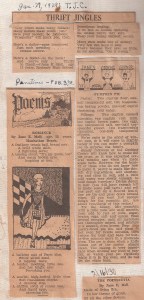

Click on the images for a close up view and enjoy Jane’s poem about romance and her jingles on how to be thrifty. Try baking the pumpkin pie.
Please use the contact tab for any comments or questions.